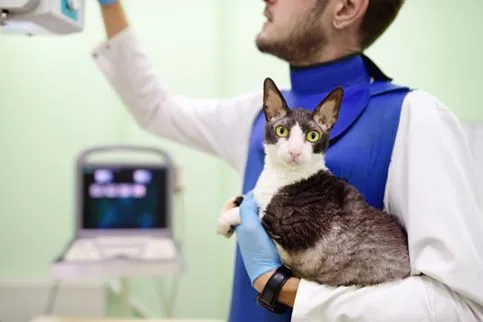
SPECIALIST DIAGNOSTIC IMAGING FOR DOGS & CATS
Pet Abdominal Ultrasound in Laguna Beach
Medically reviewed by Bryan Hayter, DVM, Owner and Medical Director of Aliso Beach Animal Clinic. Last reviewed: August 2026.
When a pet has persistent symptoms or an unexplained medical condition, an abdominal ultrasound can provide important information that may not be visible through a physical examination, bloodwork, or ordinary X-rays alone.
Aliso Beach Animal Clinic offers specialist abdominal ultrasound examinations performed at our Laguna Beach hospital by Leyla Fatourechi, DVM, DACVECC, a board-certified specialist in veterinary emergency and critical care.
This gives our patients access to advanced diagnostic imaging while allowing the examination, laboratory testing, ultrasound findings, treatment recommendations, and follow-up care to remain coordinated through their regular veterinary team.
Ultrasound studies are scheduled on an as-needed basis and can typically be arranged within one to three days, depending on Dr. Fatourechi’s availability and the medical urgency of your pet’s condition.
Abdominal ultrasound may be especially valuable for dogs and cats experiencing ongoing vomiting, diarrhea, unexplained weight loss, appetite changes, abdominal discomfort, urinary abnormalities, abnormal laboratory findings, or another condition that has not yet been clearly diagnosed.
CALL (949) 499-4190
|
REQUEST A DIAGNOSTIC EVALUATION
Abdominal ultrasound is especially useful for dogs and cats experiencing ongoing vomiting, diarrhea, weight loss, appetite changes, abdominal discomfort or abnormal laboratory results that have not yet led to a clear diagnosis.
REQUEST A DIAGNOSTIC EVALUATION
CALL (949) 499-4190
What Is a Veterinary Abdominal Ultrasound?
An abdominal ultrasound uses high-frequency sound waves to create real-time images of organs and soft tissues inside your pet’s abdomen. Unlike an X-ray, ultrasound can show the internal structure, texture, shape and movement of many abdominal organs.
The specialist moves a handheld ultrasound probe across the abdomen while viewing the images on a monitor. The examination does not use ionizing radiation.
An abdominal ultrasound may allow the specialist to evaluate:
- Liver
- Gallbladder and bile ducts
- Spleen
- Stomach
- Small and large intestines
- Pancreas
- Kidneys
- Adrenal glands
- Urinary bladder
- Abdominal lymph nodes
- Prostate gland
- Uterus and ovaries when present
- Blood vessels and abdominal fluid
Ultrasound findings are interpreted together with your pet’s history, physical examination, bloodwork, urine testing, radiographs and other available medical information.
When Should a Pet Have an Abdominal Ultrasound?
Our veterinarian may recommend an abdominal ultrasound when a pet has persistent or recurring symptoms, abnormal test results or a suspected condition involving the abdominal organs.
Ongoing Vomiting
Repeated or chronic vomiting can be associated with disease affecting the stomach, intestines, pancreas, liver, kidneys or other organs. Ultrasound may help identify intestinal thickening, abnormal motility, masses, obstruction, inflammation or other structural changes.
Persistent or Recurring Diarrhea
Diarrhea that continues, repeatedly returns or occurs with weight loss may require more than a diet change or basic laboratory testing. An ultrasound can help assess the intestinal walls, surrounding lymph nodes and other abdominal organs that may contribute to gastrointestinal symptoms.
Unexplained Weight Loss
Weight loss despite an apparently normal appetite—or weight loss accompanied by reduced appetite, vomiting or diarrhea—can be a sign of significant underlying disease. Abdominal ultrasound may help evaluate the gastrointestinal tract, liver, pancreas, kidneys, adrenal glands and abdominal lymph nodes.
Reduced Appetite
A persistent decrease in appetite can result from many medical conditions. Ultrasound may be recommended when physical examination and initial testing do not fully explain why a pet is eating less.
Abdominal Pain or Enlargement
Ultrasound may help investigate abdominal discomfort, swelling, a palpable mass or unexplained fluid within the abdomen.
Abnormal Bloodwork
Changes involving liver enzymes, kidney values, proteins, blood-cell counts or other laboratory measurements may lead the veterinarian to recommend imaging of the corresponding organs.
Changes in Urination
Blood in the urine, repeated urinary infections, difficulty urinating or abnormal kidney values may require evaluation of the kidneys, bladder, prostate or other urinary structures.
Suspected Tumor or Organ Enlargement
Ultrasound can help identify abnormal organ size, masses, nodules and enlarged lymph nodes. Imaging alone cannot always determine whether a change is benign, inflammatory or cancerous, so additional sampling may be recommended.
Unexplained Illness
An abdominal ultrasound may be an important next step when a pet remains ill despite an initial examination and testing. It is particularly useful when the clinical signs suggest disease within the abdomen but the cause remains uncertain.
Why Ultrasound May Be Recommended After Bloodwork or X-Rays
Each diagnostic test provides different information.
Blood and urine tests can reveal changes in organ function, inflammation, infection, hydration and blood-cell counts. However, they generally do not show the physical appearance of an organ.
Radiographs are useful for evaluating bones, organ size, gas patterns, some foreign objects and the overall arrangement of abdominal structures. However, organs and soft tissues with similar densities may overlap on an X-ray.
Ultrasound allows the specialist to examine many organs individually and evaluate their internal appearance in real time. For this reason, ultrasound often complements rather than replaces bloodwork and radiographs.
Conditions an Abdominal Ultrasound May Help Detect
Depending on the individual patient, abdominal ultrasound may identify or provide evidence of:
- Gastrointestinal inflammation or abnormal intestinal thickening
- Foreign material or possible intestinal obstruction
- Pancreatitis or changes involving the pancreas
- Liver or gallbladder abnormalities
- Kidney or urinary-bladder disease
- Adrenal-gland enlargement or masses
- Enlarged abdominal lymph nodes
- Organ enlargement
- Abdominal masses or nodules
- Free fluid within the abdomen
- Prostate abnormalities
- Uterine or ovarian disease
- Changes that may warrant a biopsy or other diagnostic test
An ultrasound does not always provide a final diagnosis. Some conditions have similar appearances on imaging, and certain diseases may not produce visible structural changes.
Your veterinarian may still recommend laboratory testing, a fine-needle aspirate, biopsy, endoscopy, surgery, CT imaging or another procedure depending on the ultrasound findings.
Specialist Abdominal Ultrasound at Aliso Beach Animal Clinic
Abdominal ultrasound examinations at Aliso Beach Animal Clinic are performed by
Leyla Fatourechi, DVM, DACVECC, a board-certified veterinary emergency and critical care specialist.
Dr. Fatourechi is a Diplomate of the American College of Veterinary Emergency & Critical Care. Her advanced training in the evaluation and management of medically complex and critically ill animals adds an important clinical perspective when ultrasound is being used to investigate a significant or unexplained illness.
Ultrasound is highly dependent on the experience of the clinician obtaining and interpreting the images. During a complete abdominal study, Dr. Fatourechi systematically evaluates the abdominal organs and looks for abnormalities that may help explain your pet’s clinical signs or laboratory findings.
The value of the examination extends beyond the images themselves. Ultrasound findings can be considered alongside your pet’s:
- Medical history
- Current symptoms
- Physical examination findings
- Bloodwork
- Urinalysis
- Digital X-rays
- Current medications
- Previous diagnostic testing
Dr. Fatourechi’s findings are then integrated with the case by the Aliso Beach Animal Clinic veterinarian managing your pet.
We will explain what was found, what the findings may mean, and whether the next step should involve medication, monitoring, additional laboratory testing, ultrasound-guided sampling, CT imaging, surgery, specialist referral, or another diagnostic procedure.
How Quickly Can an Ultrasound Be Scheduled?
Abdominal ultrasounds are scheduled on an as-needed basis and can typically be arranged within one to three days.
Actual timing depends on:
- Specialist availability
- Your pet’s medical urgency
- Whether preliminary testing is needed
- Whether your pet is stable enough to wait for a scheduled study
- Whether emergency or overnight care is required
Call us promptly when your pet is experiencing ongoing vomiting, diarrhea, weight loss, reduced appetite or another unexplained condition.
Call us promptly when your pet is experiencing ongoing vomiting, diarrhea, unexplained weight loss, reduced appetite, abdominal pain, significant lethargy, or another unexplained illness.
Our veterinary team will determine whether your pet should first receive an examination,
laboratory testing and in-house diagnostics
,
same-day urgent veterinary care in Laguna Beach
,
or direct evaluation at a 24-hour emergency hospital.
Specialist abdominal ultrasound can typically be arranged within one to three days, depending on availability and medical urgency. A critically ill or unstable pet should not wait for a scheduled ultrasound.
What to Expect During the Appointment
Review of Medical Information
Before the ultrasound, the Aliso Beach Animal Clinic team and Dr. Fatourechi review relevant medical history, physical examination findings, laboratory results, radiographs, current medications, and previous diagnostic testing.
If another veterinary hospital has evaluated your pet, please provide those medical records and diagnostic results before the appointment whenever possible. Having the complete clinical picture helps the specialist interpret imaging findings in context.
Clipping the Abdominal Hair
The hair over the abdomen usually must be clipped so the ultrasound probe can make adequate contact with the skin and produce diagnostic-quality images.
Water-soluble ultrasound gel or alcohol may be applied to the skin during the examination.
Positioning
Your pet will generally lie on a padded surface while the specialist examines the abdomen. The patient may be repositioned during the study so different organs can be viewed clearly.
Sedation When Needed
Many pets can undergo an abdominal ultrasound without general anesthesia. Mild sedation may be recommended when a pet is anxious, painful, unable to remain safely positioned or needs an ultrasound-guided sample.
Any sedation recommendation will take your pet’s age, health, temperament and medical condition into account.
Written Findings
The specialist prepares findings for the veterinarian managing your pet’s case. Our team will discuss the results and explain whether additional testing, medication, dietary treatment, monitoring, surgery or referral is recommended.
How to Prepare Your Pet
Preparation instructions may vary according to your pet’s condition and the purpose of the study. Follow the instructions provided specifically for your pet.
Common instructions may include:
- Withholding food for a designated period before the appointment
- Allowing access to water unless instructed otherwise
- Continuing or temporarily adjusting medication as directed
- Avoiding urination immediately before the study when bladder evaluation is important
- Bringing all current medications and supplements
- Providing previous laboratory results, radiographs and medical records
Do not withhold food, water or essential medication from a diabetic, very young, medically fragile or critically ill pet unless our veterinary team specifically instructs you to do so.
Can Samples Be Collected During an Ultrasound?
If the specialist identifies an abnormal organ, mass, enlarged lymph node or abdominal fluid, an ultrasound-guided sample may sometimes be recommended.
A fine-needle aspirate collects cells for microscopic evaluation. A biopsy collects a larger piece of tissue and may provide more information, but it may also require additional preparation, sedation or anesthesia.
Not every abnormality can or should be sampled. The recommendation depends on location, blood-clotting status, potential risk, likelihood of obtaining useful information and whether the result would alter treatment.
Sample collection is not automatically included with every ultrasound. We will discuss the recommendation, benefits, limitations and estimated cost before proceeding whenever circumstances allow.
What an Abdominal Ultrasound Cannot Tell Us
Ultrasound is a valuable diagnostic tool, but it has limitations.
An ultrasound may show that an organ or intestinal segment is abnormal without proving the exact disease responsible. For example, inflammation and certain cancers can sometimes appear similar on imaging.
Ultrasound also may not fully evaluate:
- The inside surface of the stomach or intestines
- Microscopic disease without visible structural change
- Some areas obscured by gas or other contents
- Conditions located outside the scanned area
- The exact cell type within a mass without sampling
Further testing may be required even when the ultrasound examination is thorough and technically successful.
Frequently Asked Questions
Is an abdominal ultrasound painful?
The ultrasound examination itself is noninvasive and is generally well tolerated. Some pets may be uncomfortable because of their underlying illness or when pressure is applied over a painful area.
Will my pet need anesthesia?
Most abdominal ultrasounds do not require general anesthesia. Mild sedation may be recommended for anxious or painful pets, animals that cannot remain still or procedures involving sample collection.
Why does my pet’s abdomen need to be shaved?
Hair traps air between the probe and skin, which interferes with the ultrasound image. Clipping the hair allows the specialist to obtain clearer and more reliable images.
How long does the ultrasound take?
Appointment length depends on the patient, complexity of the findings and whether additional procedures are needed. Our team will provide scheduling and arrival instructions when the study is arranged.
Will I receive the results the same day?
Many findings can be discussed promptly after the study, but the timing of the final interpretation may vary. Additional laboratory testing or specialist review may be needed before a complete treatment recommendation can be made.
Can an ultrasound diagnose cancer?
An ultrasound can identify masses, abnormal organs or enlarged lymph nodes that raise concern for cancer. However, imaging alone often cannot confirm the exact type of disease. Cell or tissue sampling may be required.
Should every pet with vomiting or diarrhea have an ultrasound?
No. A brief, uncomplicated episode may not require advanced imaging. Ultrasound becomes more important when symptoms persist, repeatedly return, occur with weight loss or reduced appetite, produce abnormal laboratory findings or remain unexplained after initial evaluation.
Is ultrasound better than an X-ray?
Neither test is universally better. They provide different and often complementary information. Your veterinarian may recommend one or both depending on the suspected condition.
Can the ultrasound be performed during an emergency?
Specialist abdominal ultrasounds at Aliso Beach Animal Clinic are scheduled according to medical need and Dr. Fatourechi’s availability. If your pet develops a sudden illness during our regular clinic hours, call (949) 499-4190 before arriving.
Many stable patients can first be evaluated through our
same-day urgent-care service
so our veterinarian can determine whether bloodwork, X-rays, ultrasound, treatment, or referral is most appropriate.
A critically ill or unstable pet may require immediate evaluation, intensive monitoring, and advanced imaging at a 24-hour emergency or specialty hospital rather than waiting for a scheduled ultrasound.
Schedule a Pet Abdominal Ultrasound in Laguna Beach
Contact Aliso Beach Animal Clinic if your dog or cat has ongoing vomiting, diarrhea, unexplained weight loss, reduced appetite, abnormal laboratory results or another condition that has not yet been diagnosed.
Our veterinary team will evaluate your pet, review any previous testing and determine whether a specialist abdominal ultrasound is the appropriate next step.
Ultrasounds are performed at Aliso Beach Animal Clinic by a visiting specialist and are typically scheduled within one to three days, depending on availability and medical urgency.
CALL (949) 499-4190
REQUEST AN APPOINTMENT
Schedule a Pet Abdominal Ultrasound in Laguna Beach
Contact Aliso Beach Animal Clinic if your dog or cat has ongoing vomiting, diarrhea, unexplained weight loss, reduced appetite, abdominal discomfort, abnormal laboratory results, urinary changes, or another medical condition that has not yet been clearly diagnosed.
Our veterinary team will review your pet’s history and previous diagnostic testing and determine whether abdominal ultrasound is the appropriate next step.
Ultrasound examinations are performed at Aliso Beach Animal Clinic by Leyla Fatourechi, DVM, DACVECC, a board-certified veterinary emergency and critical care specialist.
Appointments can typically be arranged within one to three days depending on specialist availability and medical urgency.
CALL (949) 499-4190
|
REQUEST A DIAGNOSTIC EVALUATION
Aliso Beach Animal Clinic
30816 Coast Highway
Laguna Beach, CA 92651
Directly across from the Montage Laguna Beach
Monday–Friday: 7:30 a.m.–4:30 p.m.
Saturday: 8 a.m.–12 p.m.
Sunday: Closed
For a sudden medical concern, call us before arriving. Do not submit an online appointment request for a life-threatening emergency.