
Dog Knee Surgery, CCL Tears & Orthopedic Recovery
Dog Knee Surgery in Laguna Beach: CCL, ACL-Type Injuries & Orthopedic Recovery
Medically reviewed by Bryan Hayter, DVM, Owner and Medical Director of Aliso Beach Animal Clinic. Last reviewed: October 2026.
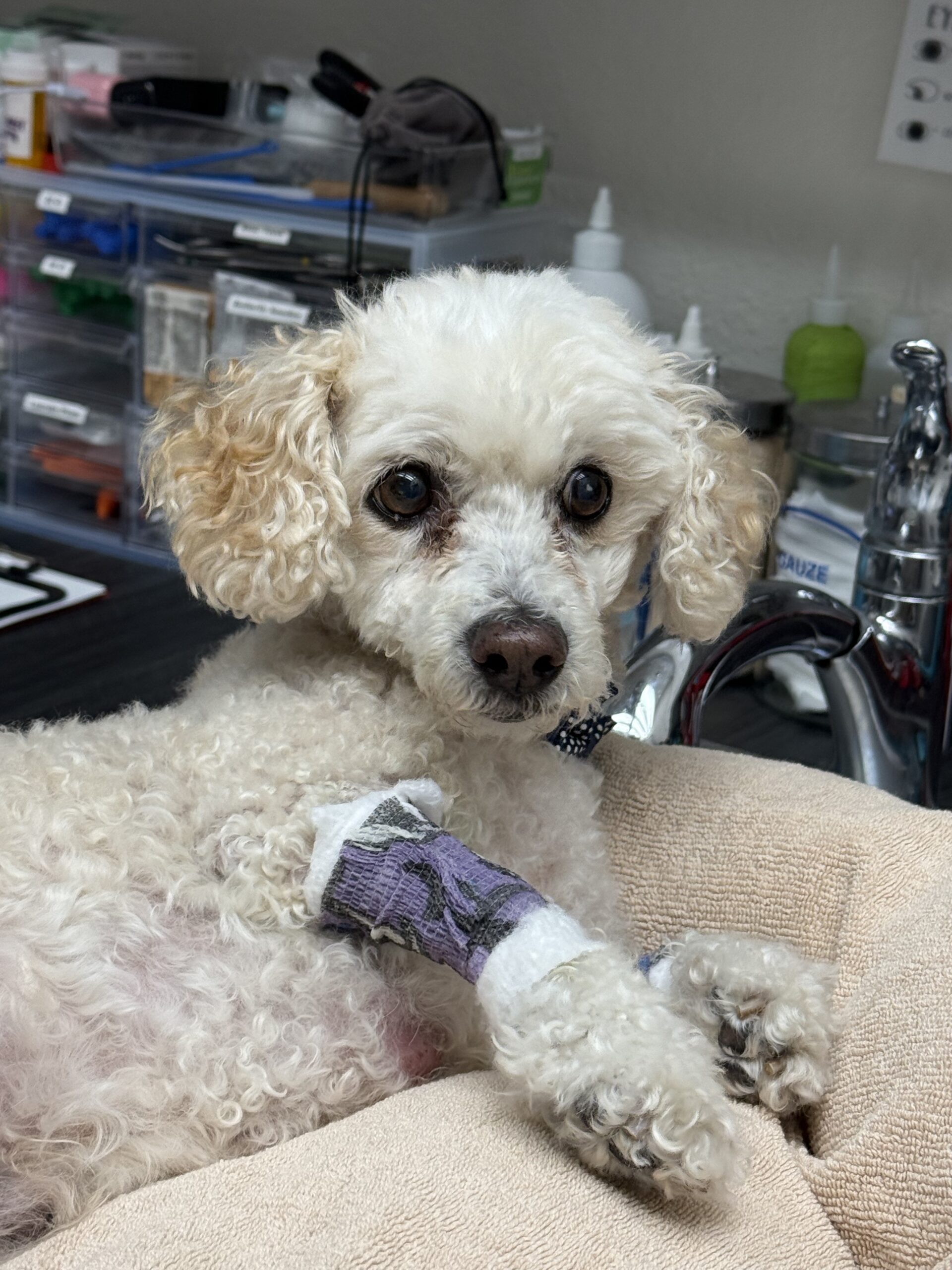
A dog that suddenly starts limping on a back leg, toe-touching, or refusing to bear weight may have a cranial cruciate ligament injury, commonly called a CCL tear. Dog owners often call this an “ACL tear,” but in dogs the correct term is usually CCL, or cranial cruciate ligament. The ligament is similar to the human ACL, but the disease behaves differently in dogs.
In people, ACL tears are often associated with a clear sports injury. In dogs, CCL disease is commonly a degenerative knee condition that may build silently over time before the dog becomes suddenly lame. Many dogs have no obvious fall, twist, or traumatic event.
The purpose of dog knee surgery is to restore a healthier gait, reduce painful knee instability, protect the meniscus when possible, and slow the progression of arthritis. No surgery can promise to prevent osteoarthritis completely. That is why timely decision-making matters: the longer an unstable knee remains painful and mechanically abnormal, the more the joint may develop meniscal injury, muscle loss, compensation, gait changes, and arthritis progression.
A Dog Not Bearing Weight Is in Significant Pain
Dogs are very good at hiding discomfort. Most dogs will continue walking, wagging, eating, and trying to participate through mild or moderate pain. A dog that is not bearing weight on a limb, holding the leg up, or only toe-touching should be treated as having severe pain or a major orthopedic problem until proven otherwise.
Do not assume that a non-weight-bearing dog “just pulled something” or will safely work it out. Acute rear-leg lameness deserves a veterinary exam, especially if your dog is painful, reluctant to rise, shifting weight, sitting strangely, limping after rest, or worsening after activity.
Quick Summary for Dog Owners
- Dogs usually tear the CCL, not the “ACL,” although owners often use ACL as shorthand.
- CCL disease in dogs is often degenerative, not a one-time sports injury.
- Typical signs include sudden back-leg lameness, toe-touching, trouble rising, sitting to one side, and worsening after activity.
- Diagnosis usually involves an orthopedic exam, tibial thrust or cranial drawer testing, and x-rays.
- MRI is rarely needed for routine CCL decision-making in dogs.
- Surgery is usually recommended for medium, large, active, or unstable dogs.
- Some dogs under about 25 pounds may recover acceptably with strict cage rest, pain control, weight management, and rehabilitation, but they must be selected carefully.
- No surgery can completely prevent arthritis, but surgery can slow arthritis progression and improve long-term comfort and gait.
- Aftercare is a major part of success. Plan on about 60 full days of careful, work-heavy restriction and rehabilitation at home, with your veterinarian, or at a physical therapy center.
- Because many dogs later tear the other knee, pet insurance is worth considering for young dogs before any orthopedic problem becomes a pre-existing condition.
CCL vs. ACL: What Is the Difference?
In people, the ligament most people know is the ACL, or anterior cruciate ligament. In dogs, the comparable structure is usually called the CCL, or cranial cruciate ligament. Both stabilize the knee, but veterinary terminology uses “cranial” instead of “anterior.”
When a dog’s CCL weakens or tears, the knee becomes unstable. The shin bone can move abnormally in relation to the thigh bone, especially during weight-bearing. That abnormal motion causes pain, inflammation, limping, cartilage stress, and progressive osteoarthritis.
A CCL tear may be partial or complete. A dog may limp mildly for weeks or months with a partial tear, then suddenly become much worse when the ligament tears further or the meniscus becomes damaged.
Why Dog CCL Tears Often Seem to “Come Out of Nowhere”
One of the most frustrating parts of CCL disease is that the dog may become acutely lame without a dramatic accident. Many owners say, “He was just running in the yard,” or “She got up from the floor and suddenly would not use the leg.”
That sudden moment may be real, but the underlying ligament often has been weakening over time. In many dogs, CCL disease is associated with a combination of genetics, body shape, weight, inflammation, activity level, knee angle, muscle condition, and progressive ligament degeneration.
This is also why the other knee matters. CCL disease is commonly a disease of the dog, not just a single unlucky knee. A substantial number of dogs that tear one CCL later develop CCL disease in the other knee, often within the next one to two years.
Signs of a CCL Tear in Dogs
Typical signs may include:
- Sudden limping on a back leg
- Toe-touching or carrying the leg
- Reluctance to bear weight
- Lameness that improves with rest but returns after activity
- Difficulty rising from lying down
- Trouble jumping into the car or onto furniture
- Hesitation on stairs
- Sitting with one back leg kicked out to the side
- Swelling around the knee
- Muscle loss in the affected thigh over time
- Clicking, popping, or sudden worsening, which may suggest meniscal injury
Some dogs are dramatically lame. Others are subtle. A partial tear can look like a recurring limp that improves and worsens over time.
Timely Decision-Making Matters
The goal is not simply to “do surgery.” The goal is to make the right decision at the right time for the individual dog.
When a knee remains unstable, the dog may continue to overload the joint, compensate through the hips and back, lose muscle, strain the opposite hind limb, and increase the risk of meniscal injury. Surgery cannot erase all future arthritis risk, but stabilizing the knee can help restore a healthier gait and slow the progression of osteoarthritis compared with leaving the knee unstable.
Waiting can be appropriate in selected small dogs or partial tears, but waiting without a structured plan is different from conservative management. A “wait and see” approach should still involve pain control, strict activity restriction, weight management, rechecks, and a clear decision point if the dog does not improve.
How We Evaluate a Dog with Suspected CCL Disease
A dog knee evaluation usually includes a complete history, gait observation, orthopedic examination, pain assessment, and a review of possible causes of rear-leg lameness.
Orthopedic Exam
During the orthopedic exam, the veterinarian may check for:
- Pain on flexion or extension of the knee
- Joint swelling or thickening
- Muscle loss
- Patellar luxation
- Hip pain
- Hock, paw, toe, or spinal pain
- Meniscal click or discomfort
- Cranial drawer motion
- Cranial tibial thrust
The cranial drawer test and tibial thrust test help identify abnormal forward movement of the tibia. These tests can be obvious in complete tears, but partial or chronic tears may be more subtle. Some dogs need sedation because strong muscles, fear, or pain can prevent a reliable exam.
X-rays
X-rays do not show the CCL itself clearly, but they are still important. Radiographs can help assess joint swelling, arthritis, bone changes, knee angle, patellar position, and other problems. They also help rule out other causes of lameness and are needed for surgical planning.
Why MRI Is Usually Not Needed
MRI is not typically part of routine CCL workup in dogs. In most patients, the diagnosis and treatment plan can be made from the history, orthopedic exam, radiographs, and surgeon assessment. MRI may be considered in unusual or unclear cases, but it is generally above the routine standard of care for most pet dogs with suspected CCL disease and is rarely needed to decide how to treat this condition.
What Else Can Look Like a CCL Tear?
Not every back-leg limp is a CCL tear. A careful exam matters because treatment can be very different depending on the true cause.
Differential diagnoses may include:
- Soft-tissue sprain or strain
- Iliopsoas or hip-flexor strain
- Toe injury, nail injury, or torn nail
- Paw pad cut, burn, foreign body, or foxtail
- Hock or Achilles tendon injury
- Patellar luxation
- Meniscal injury
- Hip injury, hip dysplasia, or hip arthritis
- Lumbosacral disease, spine pain, or nerve injury
- Fracture
- Bone tumor or other bone disease
- Immune-mediated joint disease
- Infection or tick-borne disease affecting joints
- Generalized osteoarthritis flare
This is why “try rest and see” is not always enough. A dog that is painful, not bearing weight, worsening, or not improving should be examined.
Does Every Dog with a CCL Tear Need Surgery?
Not every dog is the same. Treatment depends on body size, activity level, degree of instability, partial versus complete tear, pain, meniscal injury, age, orthopedic exam findings, weight, owner goals, and ability to follow aftercare.
When Surgery Is Usually Recommended
Surgery is commonly recommended for:
- Medium and large dogs
- Young or active dogs
- Dogs with complete tears
- Dogs with obvious knee instability
- Dogs with persistent pain or lameness
- Dogs that cannot return to comfortable function with conservative care
- Dogs suspected of having meniscal injury
When Conservative Management May Be Considered
Some smaller dogs, especially dogs under about 25 pounds, may improve without surgery if the tear is partial or if the knee can become comfortable with strict restriction, pain control, weight management, and rehabilitation. This is not the same as “doing nothing.”
Conservative management requires a serious plan and close follow-up. If the dog remains painful, repeatedly limps, cannot return to function, or becomes unstable, surgery may still be the best option.
What Strict Cage Rest Really Means
Strict cage rest is not “no dog park but otherwise normal.” It means the dog’s life is deliberately restricted to protect the knee and reduce pain.
Strict cage rest usually includes:
- Confinement to a crate, recovery pen, or very small room
- Leash-only potty breaks
- No running
- No jumping on or off furniture
- No stairs unless specifically approved
- No playing with other pets
- No slippery-floor zooming
- No off-leash yard time
- No roughhousing
- Use of non-slip rugs or mats when walking to potty
- Pain medication only as prescribed
- Rechecks to decide whether the plan is working
Small-dog conservative management can fail if the dog is allowed to “feel better” and immediately resume normal activity. Pain medication can improve comfort, but it does not make the unstable knee normal.
Dog Knee Surgery Options
There are several surgical approaches for CCL disease. The best choice depends on the dog, the surgeon, the anatomy, and the goals of treatment.
TPLO
TPLO stands for tibial plateau leveling osteotomy. It changes the biomechanics of the knee by cutting and rotating the top portion of the tibia, then stabilizing the bone with a plate and screws. TPLO is one of the most common surgical choices for active, medium, large, and many orthopedic patients because it addresses the abnormal forces that occur when the CCL is torn.
TTA and Other Osteotomy Procedures
TTA, CBLO, and related procedures also change the mechanics of the knee to improve stability during weight-bearing. The right procedure depends on the dog’s anatomy, surgeon preference, and case details.
Lateral Suture / Extracapsular Repair / “Tie-Around” Surgery
Lateral suture repair, sometimes called extracapsular repair, fishing-line surgery, or a tie-around technique, places strong material outside the joint to help stabilize the knee while scar tissue develops. This can be a reasonable option in selected smaller dogs.
For larger, young, athletic, or very active dogs, cheaper suture-based repairs may be less satisfactory. The lower price may come with tradeoffs in durability, biomechanics, long-term comfort, or arthritis progression. The best surgery is not always the cheapest surgery.
Why Surgeon Quality Matters
Dog knee surgery is not just a “procedure.” It is orthopedic planning, anesthesia, sterile technique, implant choice, bone alignment, pain control, post-operative radiographs, rechecks, complication management, and aftercare. Paying for a quality, board-certified surgeon is often one of the most important decisions owners make.
Aliso Beach Animal Clinic can help evaluate the knee, discuss options, and coordinate orthopedic care when a board-certified surgeon is appropriate. In selected cases, orthopedic surgery may be coordinated with Dr. Smith, a board-certified mobile veterinary surgeon.
The Purpose of Surgery: A Healthier Gait and Slower Arthritis Progression
The goal of CCL surgery is not to make the knee brand new. The goal is to reduce painful instability, restore more normal limb use, protect joint function, and help the dog return to a healthier gait.
Surgery cannot promise that arthritis will never develop or progress. In fact, some degree of osteoarthritis is expected in many dogs after CCL disease. However, a stable, well-aligned, well-rehabilitated knee generally has a better chance of long-term comfort than a painful, unstable knee.
This is one reason timely decision-making matters. Waiting too long can allow more compensation, muscle loss, meniscal injury, and arthritis progression before the knee is stabilized.
PRP, Stem Cell Therapy, Laser and Other Non-Surgical Options
Regenerative therapies such as platelet-rich plasma, stem-cell-based products, or other biologic injections are sometimes discussed for partial CCL injuries, early disease, or dogs whose owners are trying to delay or avoid surgery.
These approaches may have a role in selected patients, especially when used as part of a broader plan that includes restriction, weight management, pain control, and rehabilitation. However, results are mixed, and these treatments should not be presented as a reliable replacement for surgery in a dog with a clearly unstable knee, complete tear, meniscal injury, or persistent lameness.
Laser therapy, acupuncture, supplements, weight loss, and physical rehabilitation may help with pain control and mobility support, but they do not mechanically stabilize a complete CCL tear.
Why Pet Insurance Matters for Young Dogs
CCL disease has become one of the major reasons pet owners wish they had insurance before a problem appeared. Orthopedic surgery, diagnostics, anesthesia, implants, medications, rechecks, x-rays, and rehabilitation can be expensive. In many markets, CCL surgery can cost thousands of dollars per knee, and some specialty or referral settings may approach the $6,000 to $10,000 range per limb depending on the procedure, surgeon, region, hospital, and aftercare needs.
Because the opposite knee is also at risk, the lifetime cost can become much higher if both knees are affected. Pet insurance is most useful when started while a dog is young and before any limping, orthopedic diagnosis, or suspected knee problem becomes part of the medical record. Once a knee issue exists, many policies may treat it as pre-existing.
Insurance does not replace good medical decision-making, but it may allow owners to choose a higher-quality surgical and rehabilitation plan when a major orthopedic injury occurs.
Aftercare Is a Major Part of the Surgery
Dog knee surgery does not end when the incision is closed. The aftercare period is where many good surgical outcomes are protected — or lost.
Owners should plan on approximately 60 full days of careful, work-heavy aftercare, followed by a gradual return to normal activity as directed by the surgeon or veterinarian. The exact timeline depends on the procedure, the dog, the surgeon’s protocol, radiographic healing, pain level, and rehabilitation progress.
Aftercare may be done:
- At home by a committed owner
- With support from the primary veterinary team
- Through a formal physical therapy or rehabilitation center
- Through an ABAC aftercare support program when appropriate
Aliso Beach Animal Clinic does offer aftercare support for some orthopedic patients. This can be very helpful for families who cannot perform all care at home, but it adds significantly to cost and may require daily or near-daily visits depending on the patient and plan.
What At-Home Aftercare Usually Requires
Your surgeon’s protocol always comes first, but knee-surgery aftercare commonly includes:
- Strict activity restriction
- Crate, pen, or small-room confinement
- Leash-only potty breaks
- No running, jumping, stairs, furniture, or rough play
- E-collar use until the incision is healed
- Incision checks every day
- Medication on schedule
- Controlled leash walks only when approved
- Passive range-of-motion or rehab exercises if prescribed
- Non-slip flooring
- Follow-up exams and x-rays when required
- Weight control
- A gradual return to activity, not a sudden return because the dog “feels better”
The e-collar is not optional. A dog can open an incision or introduce infection very quickly. Even a few minutes of licking can create a major problem.
A dog that feels better before the bone or soft tissues are healed may try to run, jump, or twist. This is one of the most common ways aftercare fails.
Complications: What Owners Should Understand
Every surgery has risk. The goal is to reduce risk by choosing an appropriate procedure, working with an experienced surgeon, following sterile and implant-quality standards, and taking aftercare seriously.
Possible complications after CCL surgery may include:
- Infection
- Implant or device failure
- Plate, screw, or suture problems
- Prolonged limping
- Persistent or increased pain
- Incision opening or dehiscence
- Meniscal injury
- Delayed healing
- Muscle loss
- Arthritis progression
- Need for revision surgery
Complication risk can increase when corners are cut on patient selection, surgical planning, implant quality, sterile technique, surgeon experience, post-operative monitoring, e-collar use, or rest instructions. Discounted surgeries may not include the same level of surgeon training, implants, imaging, monitoring, rechecks, or aftercare support. The lowest price is not always the lowest total cost if complications occur.
What to Do Right Now if Your Dog Is Limping
Until your dog is examined:
- Stop running, jumping, stairs, dog park, fetch, and rough play
- Use a leash for all potty breaks
- Prevent access to couches, beds, and slippery floors
- Do not give human pain medication
- Do not force exercise to “see if it works out”
- Record a short video of the limp before the appointment
- Schedule a veterinary exam
Call sooner if your dog is not bearing weight, seems very painful, has swelling, cannot rise, has trauma, is crying, or has signs involving more than one limb.
Questions to Ask Before Dog Knee Surgery
- Is this a partial or complete CCL tear?
- Is there evidence of meniscal injury?
- Is there patellar luxation or another orthopedic condition?
- Which procedure is recommended and why?
- Will a board-certified surgeon perform the procedure?
- What implants or materials will be used?
- What imaging is needed before and after surgery?
- What does the first 60 days of aftercare look like?
- How many rechecks are included?
- When are follow-up x-rays needed?
- What complications should I watch for?
- What happens if my dog licks the incision?
- What if I cannot safely manage aftercare at home?
- What is the plan for weight control and rehabilitation?
- What is the risk to the other knee?
ABAC Dog Knee Surgery Support
Aliso Beach Animal Clinic helps Laguna Beach dog owners navigate knee injuries from the first lameness exam through surgical decision-making and recovery support.
Our role may include:
- Initial lameness evaluation
- Orthopedic exam
- Pain control planning
- Radiographs when appropriate
- Discussion of surgical versus conservative options
- Coordination with a board-certified surgeon
- Pre-surgical lab work and medical planning
- Post-operative rechecks
- Aftercare support when appropriate
- Weight, mobility, and long-term arthritis management
Dog knee surgery is a major decision, but it is also one of the orthopedic situations where good planning, surgeon quality, and disciplined aftercare can make a meaningful difference.
Frequently Asked Questions About Dog Knee Surgery
Is a dog CCL tear the same as a human ACL tear?
It is similar, but the terminology and disease pattern are different. In people, the ligament is usually called the ACL. In dogs, the comparable ligament is the CCL. Human ACL tears are often traumatic sports injuries, while dog CCL disease is often degenerative and may not follow an obvious traumatic event.
Can my dog recover from a CCL tear without surgery?
Some small dogs, especially dogs under about 25 pounds, may improve with strict cage rest, pain control, weight management, and rehabilitation. This is most realistic when the dog is small, the tear is partial, instability is limited, and owners can follow a strict plan. Larger, active, unstable, or persistently lame dogs usually do better with surgery.
Will surgery prevent arthritis?
No surgery can guarantee that arthritis will not develop or progress. The goal of surgery is to stabilize the knee, restore a healthier gait, improve comfort, protect function, and slow arthritis progression compared with leaving the knee unstable.
How long is recovery?
Many dogs require at least six to eight weeks of strict controlled activity, with continued gradual return to activity after that. Owners should plan for about 60 full days of serious aftercare, and some dogs need a longer rehabilitation timeline.
Why is my dog suddenly lame if there was no injury?
That is common with CCL disease. The ligament may have been weakening over time before a final partial or complete tear caused sudden lameness. Dogs may also hide early discomfort until the knee becomes significantly painful.
Is a cheaper lateral suture surgery good enough?
Sometimes it may be appropriate, especially for selected smaller dogs. However, for larger, younger, athletic, or very active dogs, suture-based repairs may be less durable or less satisfactory than procedures such as TPLO or TTA. The best choice should be made with a veterinarian or surgeon who understands the dog’s size, anatomy, activity, instability, and owner goals.
Does my dog need an MRI?
Usually no. Most dog CCL cases can be diagnosed and planned using history, orthopedic exam, cranial drawer or tibial thrust testing, x-rays, and surgeon evaluation. MRI is rarely needed for routine CCL treatment decisions.
Why do so many dogs tear the other knee?
CCL disease is often degenerative and may involve body-wide risk factors, not just one unlucky knee. Dogs that tear one CCL have a meaningful risk of developing the same disease in the opposite knee.
Can PRP or stem cells avoid surgery?
Occasionally, regenerative therapies may be considered for selected partial tears or early cases, but results are mixed. They should not be relied on as a predictable replacement for surgery when the knee is unstable, the tear is complete, or the dog remains painful and lame.
Can ABAC help with aftercare?
Yes, Aliso Beach Animal Clinic can help support recovery and may offer aftercare support for selected orthopedic patients. This can add significantly to cost and may require daily or near-daily visits depending on the plan.
Schedule a Dog Knee Evaluation in Laguna Beach
If your dog is limping on a back leg, toe-touching, refusing to bear weight, sitting strangely, or struggling to rise, call Aliso Beach Animal Clinic. We can help determine whether your dog may have a CCL tear, another orthopedic injury, or a different source of pain.
Early evaluation helps you make a better decision before compensation, muscle loss, meniscal injury, and arthritis progression become more advanced.
Aliso Beach Animal Clinic
30816 Coast Highway
Laguna Beach, CA 92651
Directly across from the Montage Laguna Beach
Monday–Friday: 7:30 a.m.–4:30 p.m.
Saturday: 8:00 a.m.–12:00 p.m.
Sunday: Closed
Medical review: Reviewed for medical accuracy by Bryan Hayter, DVM, Owner and Medical Director. Last reviewed October 2026.
Sources and Further Reading
- American College of Veterinary Surgeons — Cranial Cruciate Ligament Disease
- VCA Animal Hospitals — Cranial Cruciate Ligament Disease in Dogs
- Canine Arthritis Resources & Education — CCL Ruptures and Tears
- Cornell University College of Veterinary Medicine — Osteoarthritis
- RCVS Knowledge Canine Cruciate Registry — TPLO
- PubMed — PRP-Collagen Scaffold for Partial Cruciate Rupture in Dogs
- PubMed — PRP or Hyaluronic Acid After TPLO in Dogs
This page provides general educational information and does not replace an individualized veterinary examination, diagnosis, surgical consultation, or treatment plan. Orthopedic recommendations vary based on the dog’s size, age, anatomy, pain level, instability, activity, radiographs, medical history, owner goals, and ability to complete aftercare.