Dog Knee Surgery in Laguna Beach: CCL Tears, TPLO & Recovery
If your dog suddenly limps on a hind leg, starts toe-touching or struggles to get up, a cranial cruciate ligament (CCL) injury is one possible cause. Many owners call it a dog “ACL tear.” At Aliso Beach Animal Clinic, we examine the whole patient, explain surgical and nonsurgical options, and help families plan for the important weeks of recovery that follow.
For eligible dogs, we can coordinate advanced knee procedures, including tibial plateau leveling osteotomy (TPLO), with visiting board-certified veterinary surgeon Zachery “Zack” Smith, DVM, DACVS. Our independently owned Laguna Beach hospital remains involved with diagnostic testing, pain management, follow-up visits and individualized aftercare.
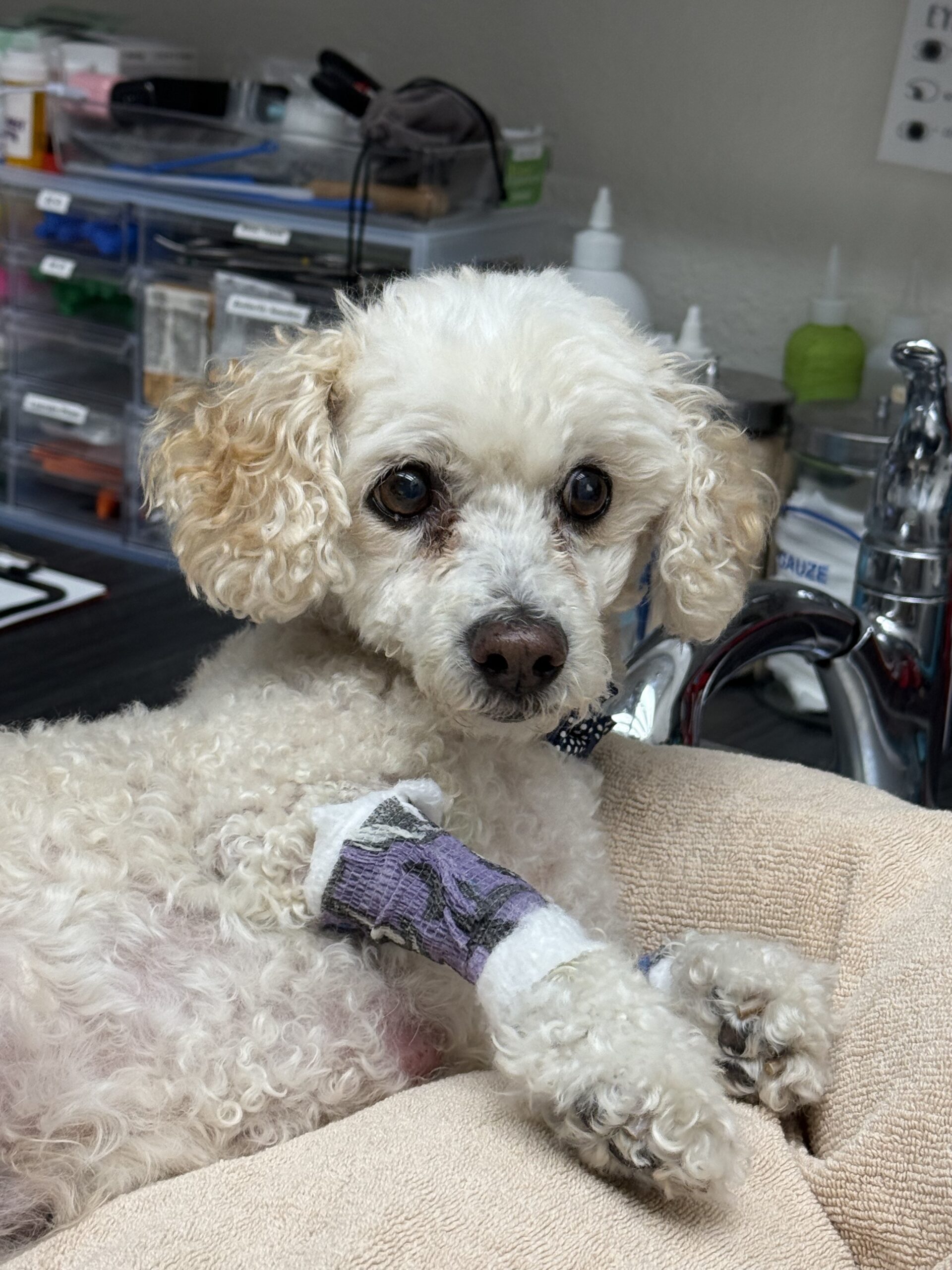
Quick answer: Most canine CCL injuries arise from a degenerative process rather than one obvious accident. Diagnosis is based on orthopedic examination, with radiographs as needed for additional assessment and surgical planning. Significant joint instability is usually treated most effectively with surgery, but management depends on the individual dog. Recovery after an osteotomy commonly involves at least 8 weeks of controlled activity and additional rehabilitation before returning to unrestricted exercise.
A Dog Not Bearing Weight Needs Prompt Assessment
A dog carrying a leg or only touching the toes to the ground may have a painful CCL injury, but non-weight-bearing lameness does not identify the diagnosis or prove a particular pain severity. Fractures, paw injuries, joint luxation, neurologic disease and other problems can also cause it. Do not force the dog to walk to “test” the leg.
Seek a timely veterinary assessment, particularly after an injury, if the leg is swollen or visibly abnormal, if your dog cries or cannot settle, or if lameness is worsening. Sudden inability to stand, suspected major trauma, an open fracture, severe uncontrolled pain or other critical signs require emergency evaluation.
For triage during clinic hours, call (949) 499-4190 or review our Laguna Beach dog-limping guide . ABAC is not a 24-hour emergency hospital.
Until examined: Use a short leash for necessary bathroom breaks, prevent running, jumping, stairs and slippery-floor accidents, and never give human pain relievers unless a veterinarian has specifically prescribed them.
Dog CCL Tears vs. Human ACL Tears: Why They Happen
In dogs, the ligament stabilizing the knee is generally called the cranial cruciate ligament (CCL or CrCL), comparable to the human anterior cruciate ligament (ACL). Injury allows abnormal movement between the femur and tibia. Unlike many human sporting injuries, canine CCL disease commonly develops through progressive ligament degeneration, sometimes before an owner notices any symptoms.
Genetics, body conformation, age, weight, activity and other factors can contribute. A dog may have intermittent lameness from a partial tear, then abruptly worsen if the ligament deteriorates further or a meniscus is injured. Because some risk factors affect both knees, the opposite knee also deserves attention; not every dog develops disease in both legs.
Common Signs of a Torn CCL in Dogs
- Sudden or recurring hind-leg limping, sometimes with no remembered injury
- Toe-touching or reluctance to bear weight
- Stiffness after rest, difficulty rising or hesitation on stairs
- Sitting with one hind leg extended to the side
- Knee swelling, pain or reduced range of motion
- Thigh muscle loss in longer-standing cases
- A painful click or sudden worsening that may raise concern for meniscal injury
These findings are not specific to CCL disease. A structured examination is important before choosing treatment.
Why Timely Decisions Matter
A persistently unstable knee can cause pain, abnormal movement, muscle weakness, meniscal injury and ongoing arthritic changes. Surgical stabilization often improves comfort and function. Arthritis can still develop or progress after repair, so the goal is better joint stability and meaningful quality of life, not the promise of an arthritis-free knee.
For specialist-authored disease information, see the American College of Veterinary Surgeons’ CCL overview .
How We Diagnose a Dog’s Knee Injury
1. Orthopedic Examination and Gait Assessment
Our veterinarian assesses when the limp began, the dog’s gait, joint swelling, muscle condition, pain and signs involving the hip, paw, hock or spine. A short video of intermittent lameness at home is often useful.
Knee-specific maneuvers include the cranial drawer and tibial thrust tests. They may be less obvious in partial or chronic tears; sedation can improve accuracy in a guarded or painful dog.
2. Radiographs and Additional Testing
Standard X-rays do not directly show the cruciate ligament well. They can identify effusion, arthritic changes, fractures and other bone abnormalities and are necessary for planning osteotomy-based surgery such as TPLO.
An exam can sometimes establish the clinical diagnosis without radiographs, but images are important when surgery or another diagnosis is being considered. MRI is not routinely required for canine CCL cases; advanced imaging may be appropriate when findings remain unclear or another condition is suspected.
Learn about ABAC’s digital veterinary X-rays and bloodwork and pre-anesthetic diagnostic testing .
3. Consider Other Causes of Rear-Leg Lameness
Differential diagnoses include a torn nail, paw pad injury or foxtail, hip osteoarthritis, luxating patella, iliopsoas strain, hock injury, fracture, tendon injury, spinal or neurologic disease, infection, immune-mediated joint disease and, less commonly, a bone tumor. The right treatment depends on the source of pain.
Does Every Dog With a CCL Tear Need Knee Surgery?
No. Treatment depends on degree of instability, tear severity, dog size, activity, concurrent joint disease, pain, general health and the family’s ability to complete care. Surgery is generally the more reliable way to control mechanical instability, particularly in large, active or persistently lame dogs. Still, selected dogs can improve with carefully supervised nonsurgical management.
When Conservative Management May Be Reasonable
Some less active, smaller or medically complex dogs, as well as certain patients with limited instability, may be candidates for a structured trial of nonsurgical treatment. This usually means restricted activity, veterinary-prescribed pain control, weight management, guided rehabilitation and reassessment.
There is no universally reliable 25-pound cutoff; body size is only one factor. Persistent pain, repeat lameness or ongoing instability may favor surgery.
What Does Activity Restriction Mean?
- A safe crate, pen or small room with non-slip flooring
- Short, controlled leash trips for toileting
- No running, fetch, jumping on furniture, rough play or off-leash yard exercise
- Stair control and assistance when recommended
- Scheduled reassessment rather than open-ended “wait and see”
Medication can help comfort but does not restore a torn ligament’s mechanical function.
Comparing Dog Knee Surgery Options: TPLO, TTA and Lateral Suture
TPLO Surgery in Dogs
Tibial plateau leveling osteotomy (TPLO) changes the angle of the tibial plateau to reduce abnormal shear forces during weight-bearing when the CCL is deficient. The surgeon makes a curved cut in the upper tibia, rotates the bone to the planned position and stabilizes it with a plate and screws.
It is commonly considered for active dogs and those with substantial instability, but is also used in selected small dogs. Healing of the osteotomy site must be protected during recovery.
TTA and Other Osteotomy Procedures
Tibial tuberosity advancement (TTA), CORA-based leveling osteotomy (CBLO) and other techniques also alter the forces acting on the knee. No single approach is best for every patient; conformation, concurrent patellar disease, surgeon experience and other anatomical considerations influence the choice.
Lateral Suture / Extracapsular Stabilization
This technique uses supportive material outside the joint to limit abnormal motion while periarticular scar tissue develops. It remains an option in selected patients, often smaller or lower-demand dogs. Differences in implant mechanics and individual outcomes deserve discussion without assuming a lower-priced operation is automatically inferior.
For a description of the specialist procedures ABAC can coordinate—including TPLO, patellar luxation correction and FHO—visit our Veterinary Orthopedic Surgery in Laguna Beach page.
Board-Certified Knee Surgery and Personal Aftercare at ABAC
For selected advanced procedures, ABAC works with Zachery “Zack” Smith, DVM, DACVS, a visiting board-certified surgeon with expertise in orthopedic and soft-tissue surgery. Dr. Smith trained at UC Davis, completed a small-animal internship and surgical residency, and founded Veterinary Orthopedics of California. He performs qualifying surgeries at ABAC by arrangement; availability and location of surgery depend on the case and the team.
Read Dr. Zack Smith’s professional biography at Veterinary Orthopedics of California →
ABAC’s advantage is the continuity around the procedure: a familiar team can coordinate the initial exam, preoperative workup, postoperative medication and incision checks, gait and mobility reassessments, and surgical rechecks.
When arranged ahead of time, additional assisted aftercare visits may be available for selected patients, depending on medical need, scheduling and costs. ABAC does not offer 24-hour postoperative hospitalization.
What About PRP, Stem Cells, Laser Therapy and Rehabilitation?
Platelet-rich plasma (PRP), stem-cell-based approaches and other regenerative interventions are being studied, but protocols and evidence vary. They should not be presented as proven replacements for surgical stabilization in a dog with a clearly unstable knee or a complete CCL tear. Discuss the evidence, costs, regulatory status and realistic objectives with the veterinarian.
Physical rehabilitation can improve function and support recovery. Pain-control plans may also include weight optimization, appropriate medication and selected adjunctive treatments. Therapeutic laser and integrative pain and mobility care may be considered where appropriate, but do not replace mechanical stabilization, surgeon-directed restrictions or prescribed medications.
After Dog Knee Surgery: Recovery Is Part of the Treatment
Many osteotomy-based CCL procedures require at least 6–8 weeks of closely restricted activity, with controlled rehabilitation commonly continuing through 8–12 weeks or longer. Returning to unrestricted play or sport can take several months.
The surgical protocol, examination findings and follow-up radiographs determine when activity can increase. Early willingness to walk is not proof that bone or soft tissue is fully healed.
Complete TPLO Recovery Instructions
For the detailed week-by-week schedule—including days 0–3, incision care, leash walking, surgeon-approved exercises, recheck timing, and return-to-beach activity—see our Dog TPLO Recovery Guide: Week-by-Week Care After Cruciate Surgery .
Follow your dog’s surgeon’s discharge instructions first. Not every listed exercise or milestone is safe for every patient.
Important At-Home Responsibilities
- Keep the recovery area calm and use traction on slippery floors.
- Prevent jumping, running, rough play and unapproved stairs.
- Give prescribed medications on schedule; never add human pain medication.
- Protect the incision with the veterinarian-recommended cone or alternative protective device.
- Inspect the incision regularly and report worsening redness, discharge, swelling or separation.
- Attend planned follow-up exams and radiographs, even if your dog looks comfortable.
- Start exercises or increase walks only when instructed by the surgeon or rehabilitation professional.
Recognizing Complications
Possible complications include infection, implant problems, delayed bone healing, persistent lameness, pain, meniscal injury, muscle loss and arthritis progression.
Call promptly if your dog suddenly stops using the leg after improvement, has significant new swelling, develops fever or incision drainage, or cannot tolerate medications. Emergency signs such as collapse, severe bleeding or breathing difficulty require immediate 24-hour care.
ABAC’s Hands-On Recovery Support
ABAC can help coordinate scheduled incision assessments, medication reviews, gait checks, diagnostic imaging, weight management and return-to-activity guidance. Additional in-clinic assistance may be possible for some families.
The number and frequency of visits, what is included in surgical fees, and the availability of extended aftercare should be clarified before surgery; daily or overnight care is not guaranteed.
What Should I Compare When Choosing a Dog Knee Surgeon?
The lowest quoted surgery fee and the highest fee do not by themselves establish quality. Ask about surgeon qualifications; the reason for the recommended procedure; anesthesia monitoring and pain control; implants; meniscus assessment; postoperative instructions; anticipated radiographs and rechecks; access to complications management; and the total expected cost, including rehabilitation or added aftercare.
Consider pet insurance before an orthopedic issue arises if it fits your family’s needs. Policies differ in pre-existing condition definitions, waiting periods and bilateral cruciate exclusions; review the actual contract rather than assuming coverage.
The RCVS Knowledge Canine Cruciate Registry is an independent effort to improve quality of care through prospective clinical-outcome tracking.
Dog Knee Surgery and CCL Evaluations Near Monarch Beach and Emerald Bay
Aliso Beach Animal Clinic is an independently owned veterinary hospital at 30816 Coast Highway, Laguna Beach, CA 92651 , directly across from Montage Laguna Beach. We assist families in South Laguna, Three Arch Bay, Emerald Bay, Monarch Beach, Dana Point, Laguna Niguel and nearby coastal Orange County with lameness evaluation, surgical decision-making and recovery planning.
When your dog is struggling with a painful knee, our goal is to help you make an informed choice—not assume every limping dog needs surgery. If advanced stabilization is appropriate, we can discuss whether surgery at ABAC with a visiting specialist and our coordinated aftercare model is a good fit.
Frequently Asked Questions About Dog CCL Tears and TPLO
Is a dog’s CCL tear the same as a human ACL tear?
The ligaments have comparable roles, but canine CCL disease is frequently degenerative and may develop without a dramatic athletic injury. The terms differ: cranial cruciate in dogs and anterior cruciate in people.
Can a dog recover from a cruciate tear without surgery?
Selected dogs may improve with a structured nonsurgical plan, particularly when instability and functional demands are limited. That improvement does not necessarily restore normal knee mechanics; repeated lameness or persistent instability should prompt reassessment.
Does every dog need an MRI before cruciate surgery?
No. Orthopedic examination and appropriately planned radiographs are sufficient for many cases. MRI or other advanced imaging is used selectively when the diagnosis is unclear or other injuries are suspected.
Will TPLO prevent arthritis?
No. TPLO reduces abnormal forces in the CCL-deficient knee and often improves function, but arthritic changes can still develop or progress. Weight management, activity planning and long-term monitoring remain important.
How long does TPLO recovery take?
Bone healing commonly requires roughly eight weeks or more. Controlled activity often extends through 8–12 weeks, and return to full athletic function may take additional months. Follow the surgeon’s own timeline and recheck recommendations.
Does my dog have to weigh less than 25 pounds for nonsurgical management?
No strict weight cutoff determines the right choice. Size is one consideration among stability, anatomy, pain, activity, medical conditions and response to supervised nonsurgical treatment.
Can PRP or stem cells repair a complete torn CCL?
There is insufficient reliable evidence that these treatments restore normal mechanical stability or replace surgery for a significantly unstable knee. Ask your veterinarian to explain the specific evidence for any recommended product or procedure.
Can ABAC arrange surgery with Dr. Zack Smith?
For eligible cases, ABAC coordinates scheduled procedures with visiting board-certified surgeon Zachery Smith, DVM, DACVS. Availability depends on the case and surgeon schedule; an orthopedic assessment is the appropriate starting point.
Can ABAC help with follow-up visits after knee surgery?
Yes. The clinic can coordinate appropriate planned rechecks and may offer extra assisted aftercare for selected patients, subject to the treatment plan, staffing and additional charges. ABAC is not a 24-hour surgical hospital.
Will the other knee develop the same problem?
Some dogs develop cruciate disease in the opposite knee, sometimes within a year or two, but not every dog does. Maintaining a lean body condition, recognizing early lameness and discussing new signs promptly remain worthwhile.
Veterinary References and Surgical Credentials
Schedule a Dog Knee Evaluation in Laguna Beach
Whether your dog has a sudden rear-leg limp, a suspected torn CCL, an unstable knee or persistent lameness after rest, ABAC can evaluate the problem and discuss options, including surgery with Dr. Smith when appropriate.
Aliso Beach Animal Clinic
30816 Coast Highway
Laguna Beach, CA 92651
Across from Montage Laguna Beach
Monday–Friday: 7:30 a.m.–4:30 p.m. · Saturday: 8 a.m.–noon · Sunday: Closed
For emergencies, do not rely on an online appointment request. Severe trauma, collapse or other life-threatening problems may require immediate care at a 24-hour emergency veterinary hospital.